June 18, 2026
If you have been comparing concierge primary care with traditional primary care, you are not alone. Many patients feel frustrated by rushed appointments, long waits for follow-up, and the sense that modern healthcare can become reactive instead of personal. At the same time, paying a membership fee for medical care can raise fair questions about value, access, and whether concierge medicine is really different from simply having a good primary care physician.
The short answer is that both models are forms of primary care, but they are organized very differently. Traditional primary care usually works through insurance, standard office scheduling, and larger patient panels. Concierge medicine, sometimes called membership medicine or membership-based healthcare, adds a monthly or annual fee in exchange for more physician time, easier access, and a smaller patient panel. In some practices, concierge care still bills insurance for covered services. In related models such as direct primary care, insurance may not be billed at all. The American Academy of Family Physicians notes that direct primary care and concierge medicine overlap, but they are not the same thing.
That does not mean concierge medicine is automatically better care in every situation. In fact, the American Medical Association’s ethics guidance on retainer practices specifically says physicians should not imply that a retainer contract means more or better medical services. The best model depends on your health needs, budget, insurance, schedule, and how much direct physician access matters to you.
For patients considering concierge primary care in Sarasota, this article walks through the evidence, explains the tradeoffs, and helps you decide which model may fit your life best.
Understanding Traditional Primary Care
Traditional primary care is still the backbone of the U.S. healthcare system. The Agency for Healthcare Research and Quality describes primary care as a core component of the health system and the largest platform of formal healthcare in the United States. In plain language, it is the place most people go first for preventive care, acute minor illness, long-term health management, prescriptions, referrals, and coordination with specialists.
In a traditional model, your primary care physician or advanced practice clinician usually works within an insurance-based system. That means the clinic bills your health plan, Medicare, or Medicaid for covered visits and services. For patients, the direct cost often comes through premiums, copays, coinsurance, and deductibles rather than through a separate membership fee. Many preventive services are covered at no extra cost under Marketplace plans, and Medicare Part B covers most preventive services with no cost-sharing when certain rules are met.
This model has important strengths. It is familiar, widely available, and often more affordable up front than concierge care. It may also be the best fit if you already have a trusted doctor, your office offers timely appointments, and your care needs are fairly routine. Traditional primary care is also where many patients access screenings, vaccines, medication refills, wellness care, and referrals through existing insurance networks. For patients comparing care options on the broader menu of medical services, this remains the standard starting point for most healthcare decisions.
The challenge is that traditional primary care often operates under major time pressure. A large study in JAMA Health Forum reported that the average primary care visit lasts about 18 minutes. The same paper noted that a typical primary care panel would require about 27 hours per day to deliver all guideline-recommended preventive, chronic disease, and acute care. That mismatch helps explain why many patients feel visits are rushed even when their physician is doing everything possible within the system.
Patient panel size is part of that story. Older but still widely cited research estimated the average U.S. primary care physician panel at about 2,300 patients, while newer family medicine discussions suggest many panels today are lower but still often very large. That said, traditional primary care should not be confused with bad care. Strong primary care is associated with better access, better health outcomes, lower hospitalization, and lower overall cost of care. The issue is usually not the value of primary care itself. The issue is whether the structure around it gives enough time and access.
Understanding Concierge Medicine
Concierge medicine is a form of primary care organized around a membership fee. The Cleveland Clinic’s overview of concierge medicine explains that members commonly pay a monthly or annual fee for services that may include same-day or next-day appointments, longer visits, direct access by phone, email, or portal, and care coordination.
Patients often hear several related terms used almost interchangeably: concierge medicine, concierge primary care, retainer medicine, membership-based healthcare, and direct primary care. These models all try to create more time and more direct physician access, but they are not identical. If you are researching membership-based healthcare, it is worth asking each practice exactly how it handles insurance, labs, imaging, specialists, and hospital care.
The appeal of concierge medicine is easy to understand. Smaller panels can make it easier to offer longer appointments, proactive follow-up, and easier communication between visits. Patients who feel overlooked in a high-volume system may especially value being able to reach their own concierge doctor more directly and spend more time discussing prevention, multiple symptoms, medication changes, or specialist recommendations.
The model is also growing. Still, the evidence base has limits. The American College of Physicians has stated that there is relatively little high-quality, independent research on the effects of concierge and other direct patient contracting models on quality and access. ACP also notes that these models may create access concerns for patients who cannot afford to pay directly for care. That is one reason an honest discussion of concierge medicine vs traditional primary care needs to include both benefits and limitations.
Key Differences Between Concierge Medicine and Traditional Primary Care
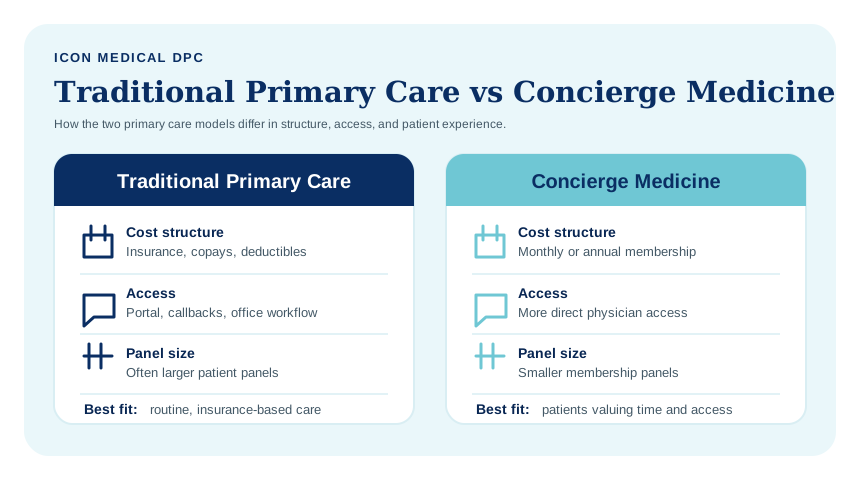
The biggest differences usually come down to time, access, panel size, and how the practice is paid. Those structural differences can change the patient experience in ways that are noticeable almost immediately.
| Care Feature | Traditional Primary Care | Concierge Medicine |
|---|---|---|
| Appointment length | Often shorter because clinicians balance high demand and large schedules. | Often longer, with more time for layered concerns and follow-up. |
| Physician access | Usually routed through staff, portal queues, or standard phone workflows. | Often includes more direct physician access by phone, text, email, or portal. |
| Patient panel size | Generally larger patient panels. | Generally smaller patient panels. |
| Preventive care focus | Preventive care is available, but time may compete with urgent concerns. | More time may support deeper preventive planning and tracking. |
| Chronic condition support | Can be excellent when follow-up systems are strong. | May be easier when frequent communication and medication adjustments are needed. |
| Care coordination | Varies by office, system, and available staff time. | Often positioned as a central benefit of the membership model. |
| Cost structure | Usually insurance-based with premiums, copays, deductibles, and coinsurance. | Usually includes a monthly or annual membership fee; insurance use varies by practice. |
Appointment Length
Traditional primary care visits are often short because clinicians are balancing high demand with limited time. That does not mean every visit is inadequate, but it does mean patients with multiple concerns may need to prioritize what gets covered in one appointment.
Concierge medicine is designed to create longer visits, although there is no universal standard. The Cleveland Clinic description of concierge care lists longer appointment times as a common feature, and smaller panels are what typically make those longer visits possible. For patients with layered concerns such as blood pressure, medication side effects, sleep, weight, exercise, and stress, more time can make the visit feel more complete and less rushed.
Physician Accessibility
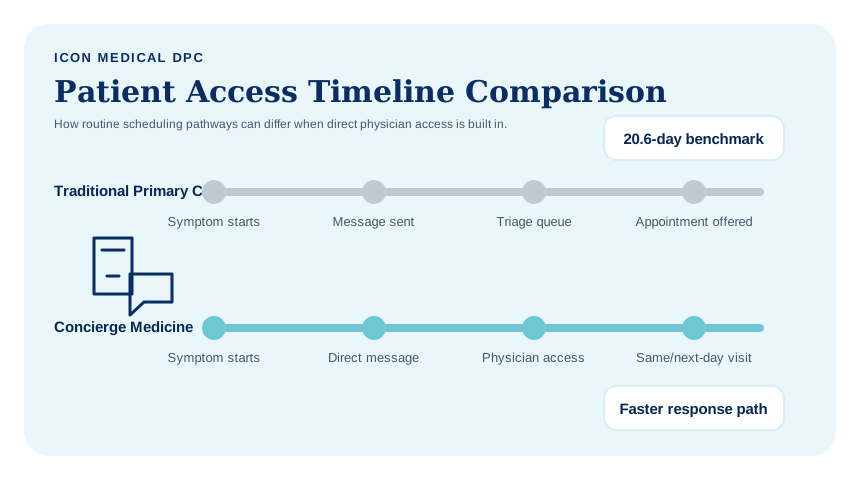
Accessibility is where concierge medicine often feels most different to patients. Common concierge features include same-day or next-day appointments, direct access by email, phone, or portal, and even expanded physician availability in some programs. Not every practice offers all of those features, but more direct physician access is a defining part of the model.
Traditional primary care can certainly offer good access, especially in well-run offices. But in a large system, patient communication is often routed through scheduling staff, nurses, call centers, or portal messaging queues. That can work well for many issues. It can also feel slow or fragmented when you are anxious, traveling, managing a medication change, or trying to decide whether a symptom needs urgent attention.
The difference shows up in appointment timing too. A survey summarized by the American Academy of Family Physicians found that average wait times for new-patient, non-emergent family medicine appointments were 20.6 days in the surveyed markets. By contrast, same-day or next-day scheduling is routinely presented as a standard benefit of concierge care.
Patient Panel Size
Panel size means the number of patients assigned to a physician or care team. It is one of the most important structural differences between these models because it shapes nearly everything else, from schedule flexibility to follow-up capacity.
Traditional primary care panels are generally much larger. Older U.S. estimates put average panels around 2,300 patients, and newer analyses still place many traditional family medicine panels well into the high hundreds or low thousands. Even when team-based care improves efficiency, large panels can make it harder to provide rapid scheduling and intensive follow-up for every patient.
Membership models usually operate with smaller panels. The AAFP reports that the average direct primary care panel is about 413 patients. In the American College of Physicians’ position paper, retainer-only physicians who could estimate panel size reported panels ranging from 100 to 425, averaging about 250 patients. These are not identical models, but both show how dramatically smaller membership-based panels can be.

Preventive Care Focus
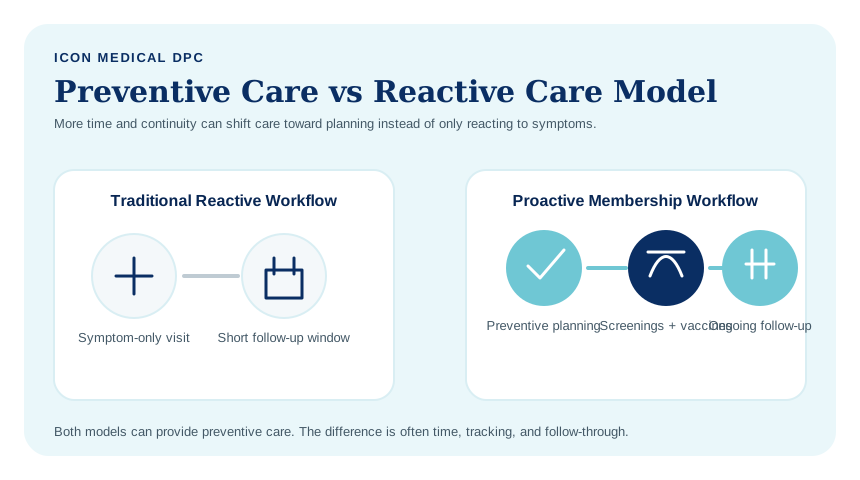
Both traditional and concierge practices can provide excellent preventive care. Screening tests, vaccines, counseling, and lifestyle guidance are not exclusive to any one payment model. The Centers for Disease Control and Prevention explains that preventive care includes screenings for early detection, vaccines, and counseling or education to support better health decisions.
The difference is often not whether prevention is offered, but how much time and follow-through the practice can devote to it. In a time-pressured traditional visit, preventive counseling can compete with pressing acute or medication issues. In a smaller-panel membership practice, there may be more room for deeper conversations about sleep, exercise, nutrition, stress, weight change, travel, aging, and future risk reduction.
Insurance-based primary care still has a major financial advantage here. Many preventive services are covered at no cost under applicable Marketplace plans, and Medicare covers many preventive services as well. So while concierge practices may offer more time for prevention, patients should remember that the actual screening tests, vaccines, and downstream care often depend on insurance benefits, Medicare rules, or separate out-of-pocket costs.
Chronic Disease Management
For patients with hypertension, diabetes, high cholesterol, thyroid disease, asthma, weight concerns, menopause symptoms, multiple medications, or several specialists, continuity matters. Research consistently shows that patients with access to a regular primary care physician have lower overall healthcare costs and better outcomes than those without one. Regular primary care can also improve chronic disease tracking and whole-person care over time.
Traditional primary care can absolutely manage chronic disease well, especially when the office has strong systems and the patient can get timely follow-up. But if your condition requires frequent medication adjustment, close symptom monitoring, or detailed lifestyle coaching, the larger structure of traditional care may feel limiting.
This is one area where concierge medicine may be especially appealing. More time, easier communication, and faster follow-up can make it easier to review labs, adjust treatment, check in after medication changes, and coordinate with specialists between appointments. That does not mean the diagnosis or medication choice is automatically superior. It means the process of managing the condition may be more convenient and more attentive.
Care Coordination
One of the least discussed but most important jobs of primary care is care coordination. The AHRQ care coordination definition describes deliberately organizing patient care activities and sharing information among participants in care to achieve safer and more effective care.
For patients who see cardiologists, endocrinologists, orthopedists, neurologists, physical therapists, or hospital-based clinicians, this can be the difference between feeling guided and feeling lost. Traditional primary care offices do this every day, but the amount of time available for detailed chart review, phone calls, specialist follow-up, and family communication varies a lot by practice.
Concierge medicine often places care coordination front and center. For patients with several doctors or complex records, that added attention may be one of the most meaningful advantages of the membership fee.
What Does Concierge Medicine Cost?
Cost is where many patients pause, and that is reasonable. Unlike traditional primary care, concierge medicine adds a clear membership price on top of the other ways healthcare is typically financed. Depending on the practice, that fee may be monthly, quarterly, or annual. Membership fees often cover access, physician time, and certain in-office services, but they usually do not replace insurance for hospital care, imaging, specialist care, procedures, or many prescriptions.
There is no single national price. Older literature placed some typical annual retainer fees around $1,500 to $1,700, but current published pricing can be much higher depending on the market and model. That wide range is why patients should look beyond the headline number. Ask what the fee actually includes. Does it cover unlimited visits? Telehealth? After-hours calls? Annual physicals? Basic labs? Medication management? Specialist coordination?
By contrast, traditional primary care usually does not require a separate membership. Your costs are generally shaped by your insurance design, deductible, copays, and coinsurance. Marketplace plans must cover many preventive services at no cost, and Medicare Part B covers many doctor and preventive services, though cost-sharing may apply in some situations and for non-preventive care.
For many patients, the comparison is not simply free versus paid. It is really indirect costs through insurance and time tradeoffs versus direct membership cost for more access and time. If you are evaluating Icon Medical membership locally, the most useful question is not just how much it is, but what medical access, convenience, continuity, and clinician time you are actually buying.
Is Concierge Medicine Worth the Cost?
Worth it is a personal decision, not a universal one. For some patients, the value comes from faster access, more time with the physician, easier medication follow-up, and less friction when health concerns come up unexpectedly. For others, the extra fee may not make sense if they are generally healthy, already have a strong relationship with a traditional primary care physician, or would rather spend that money on insurance premiums, medications, therapy, fitness, or specialist care.
The evidence here is mixed and still evolving. The American College of Physicians has said the independent evidence on concierge and related direct contracting models is limited. A 2023 study found large healthcare spending increases and no average mortality effect for patients affected by a switch to concierge medicine. That does not mean concierge care has no value. It means patients should be careful not to assume that more expensive access automatically equals better long-term outcomes on every measure.
In other words, the fee may be worth it if the membership solves a real problem in your life. Examples include difficulty getting timely appointments, frequent need for detailed follow-up, managing several conditions at once, traveling often, caregiving for a parent, or simply wanting a more direct relationship with your physician.
Who Benefits Most from Concierge Medicine?
Patients who benefit most from concierge medicine are usually those who feel the limits of traditional scheduling most strongly. That often includes adults with multiple chronic conditions, people taking several medications, older adults juggling multiple specialists, professionals who travel frequently, caregivers managing family health issues, and patients who simply need more time than a brief standard visit allows.
Patients with high-touch needs may also find concierge care helpful after a hospitalization, during a period of uncontrolled blood pressure or diabetes, while sorting out vague symptoms, or when trying to coordinate complex records across several health systems. In these situations, easier access and more physician time can reduce delays and improve the day-to-day experience of care.
On the other hand, not everyone needs a membership model. Traditional primary care may still be appropriate if your health is stable, your current office is responsive, you mainly want insurance-covered preventive services, or the added fee would create financial stress. Community-based, insurance-based primary care remains medically sound and remains the right fit for millions of patients.
Common Misconceptions About Concierge Healthcare
One common misconception is that concierge care means better doctors. That is not a fair or evidence-based conclusion. Many outstanding physicians practice in traditional offices, academic systems, community clinics, and hospital-owned groups. The main difference in concierge medicine is usually the practice structure, especially panel size, access, and time.
Another misconception is that concierge medicine replaces health insurance. Many concierge practices still recommend or require insurance for hospital care, specialist visits, imaging, emergency care, and nonincluded services. If a practice does not bill insurance, that does not mean insurance becomes unnecessary. It usually means the membership is covering the primary care relationship, not every part of the healthcare system.
A third misconception is that traditional primary care is always impersonal. Some traditional practices do a remarkable job with continuity, communication, and prevention despite major system constraints. If you already have a physician who knows you well, answers messages promptly, and can see you without long delay, you may already be getting many of the relationship benefits patients seek in concierge care.
Frequently Asked Questions
Is concierge medicine the same as direct primary care?
Not exactly. The AAFP says direct primary care usually charges a lower recurring fee, generally does not bill insurance, and often includes a broad set of primary care services. Concierge medicine often charges a higher membership fee and may still bill insurance for covered services.
Do I still need health insurance if I join a concierge practice?
Usually, yes. Many concierge practices do not replace insurance for hospital care, specialist visits, imaging, surgeries, or emergency care. Some also bill insurance separately for covered services. Always ask exactly what is included and what is not.
Does concierge medicine guarantee same-day appointments?
Not every practice guarantees it, but same-day or next-day appointments are commonly offered and are a standard feature in many concierge programs.
Are appointments actually longer in concierge medicine?
Often, yes, but the exact length varies by practice. Concierge programs commonly advertise longer visits, while one large study found average traditional primary care visits around 18 minutes.
How much does concierge medicine cost?
There is no universal price. Older literature placed some typical annual retainers around $1,500 to $1,700, while more recent reporting shows current memberships can range from the low-thousands to tens of thousands of dollars per year depending on the model and market.
Is traditional primary care still a good option?
Absolutely. Strong traditional primary care remains essential and is associated with better access, better health outcomes, and lower overall cost. It is still the right fit for many patients.
Can concierge medicine help with chronic disease management?
It may help by making follow-up, medication adjustment, and communication easier, especially for patients with several conditions or specialists. But the value comes mostly from structure and access, not from a guarantee of a different diagnosis or superior medical judgment.
Does Medicare cover concierge membership fees?
Generally, membership fees themselves are not covered like standard Medicare benefits. Medicare may still cover approved services separately, depending on how the practice is structured and what coverage rules apply.
Concierge Medicine in Sarasota, Florida
For patients researching concierge medicine Sarasota, local context matters. U.S. Census QuickFacts for Sarasota County shows an older-than-average population, and Sarasota County reports a significant seasonal population increase. That combination can shape how patients think about access, continuity, and appointment availability.
Sarasota also has real healthcare access pressures. A community health needs assessment for Sarasota County reported that much of the county is designated as a Health Professional Shortage Area for primary care, mental health, and dental services for low-income residents. Even when countywide provider ratios look better than some state or national averages, access can still feel tight depending on insurance status, transportation, seasonal demand, and the complexity of your medical needs.
That is one reason local patients in Sarasota, Gulf Gate Estates, Siesta Key, Palmer Ranch, Osprey, and South Sarasota may ask different questions than patients in other markets. Some are retirees managing several specialists. Some are seasonal residents who split time between Florida and another state. Some are working adults trying to fit healthcare into a busy schedule. Some are pilots or aviation professionals who also need FAA medical exams and ongoing primary care under one roof.
For local patients, the practical comparison often comes down to this: how easy is it to get questions answered, how much time do you get during visits, how smoothly does the office help coordinate outside care, and how well does the structure fit your life in Sarasota? Those are the same core questions whether you are evaluating a hospital-owned traditional practice, an independent family doctor, or a membership-based office such as concierge primary care.
If you want to compare models thoughtfully, start with specifics rather than labels. Ask what is included, what is billed separately, how quickly you can be seen, and how the office handles prevention, chronic disease follow-up, specialist communication, and urgent questions when you are out of town. You can contact Icon Medical for straightforward information about local logistics and included services.
Final Thoughts
When patients ask about concierge medicine vs traditional primary care, they are usually asking a deeper question: what kind of relationship do I want with my doctor, and what structure will best support my health? That is the right question to ask.
Traditional primary care remains highly valuable, evidence-based, and appropriate for many people. It is essential to the health system, often more affordable up front, and fully capable of delivering excellent preventive and chronic care. Concierge medicine, meanwhile, tries to solve practical problems that many patients feel in real life: short visits, limited access, fragmented communication, and difficulty coordinating complex care.
The tradeoff is simple but important. Concierge medicine usually asks patients to pay more directly in exchange for more time and easier access. For some patients, that tradeoff is worthwhile. For others, it is not necessary. Neither choice makes you a better patient, and neither model should be presented as the only valid way to receive good healthcare.
The best next step is to compare your own needs honestly. Think about your health complexity, your schedule, your insurance, your comfort with technology, your budget, and how much direct access to your physician matters to you. If you are evaluating a local practice led by Dr. Josephine Olsen, or any other physician, the goal is the same: choose the primary care model that gives you the right combination of trust, access, affordability, and continuity.
If you are ready to ask specific questions about a local membership model, you can schedule a meet and greet with Icon Medical.