June 18, 2026
If you have searched what is concierge medicine, the shortest accurate answer is this: concierge medicine is a membership-based form of medical care in which a patient pays a recurring fee in exchange for more direct access, more time with the physician, and a smaller patient panel than is typical in standard primary care.
Depending on the practice, the doctor may still bill insurance or Medicare for covered services, or the practice may function more like direct primary care and avoid insurance billing for most primary care services. The model is also commonly described as retainer-based medicine, boutique medicine, membership medicine, or direct care, although those labels are not always used consistently.
For patients, the appeal is easy to understand. Many people want a primary care relationship that feels less rushed, more personal, and easier to access when something goes wrong. They want a concierge doctor who knows their history, responds when they call, and can help coordinate care instead of just reacting to isolated problems.
Why Patients Are Asking About Concierge Medicine Now
Patients are asking about concierge medicine partly because access to ordinary primary care has become harder in many places. The Association of American Medical Colleges says the United States could face a physician shortage of up to 86,000 doctors by 2036, and current policy analysis from the National Academy of Medicine notes that the average wait to schedule a family medicine appointment is 20.6 days. In plain language, patients are feeling the consequences of a strained primary care system: fewer openings, more rushed visits, and more barriers between the patient and the clinician.
That matters because high-quality primary care is not optional background infrastructure. The National Academies describes primary care as the foundation of the health system in Implementing High-Quality Primary Care, and Healthy People 2030 explains why access to primary care supports preventive services such as blood pressure checks, vaccines, and cancer screening.
Continuity matters too. A large review on primary medical care continuity and patient mortality found lower mortality with higher continuity, and a JAMA Network Open study on an employer-sponsored comprehensive primary care delivery model found that regular primary care visits with the same clinician were strongly associated with Medicare savings.
This conversation is especially relevant in Sarasota. Sarasota County demographics show an older, seasonal, and fast-changing local population, while U.S. Census QuickFacts for Sarasota County, Florida places the county population near 480,000. Those local realities mean many residents are older adults, caregivers, retirees, snowbirds, or people coordinating care across multiple settings.
What Concierge Medicine Actually Means
At its core, concierge medicine is a physician-patient relationship built around a membership fee. Medicare’s concierge care coverage guidance says concierge care is when a doctor or group charges a membership fee before they will see you or accept you into the practice. The U.S. Government Accountability Office similarly describes concierge care as an approach in which physicians charge a membership fee in return for enhanced services or amenities.
One reason patients get confused is that not every membership model works the same way. In everyday conversation, people may use concierge medicine, membership medicine, direct care, and direct primary care interchangeably. But policy sources make important distinctions. The American Academy of Family Physicians explains that direct primary care usually charges a lower monthly fee, generally does not participate in payer programs, and applies membership fees to a broad range of primary care services.
So when a patient asks, “What is concierge medicine?” the best answer is not a slogan. It is a customizable membership model of primary care or physician access in which the practice limits panel size and offers enhanced availability in exchange for a recurring fee, but the exact insurance rules and included services vary by practice.
For local context, Icon Medical in Sarasota describes its model as concierge-style primary care with same-day and next-day appointments, unlimited telemedicine, and direct communication by phone, text, or email. That is one concrete example of how personalized healthcare and direct physician access can be structured in a Sarasota practice, but patients should still evaluate any concierge offering by reviewing the actual membership terms, what is included, and what costs extra.
How Concierge Primary Care Works in Real Life
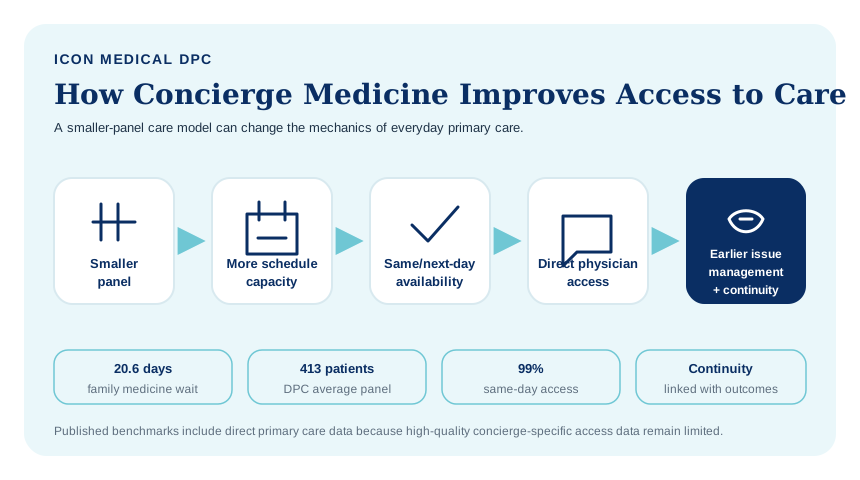
Most patients do not experience concierge medicine as an abstract payment model. They experience it as a different access pattern. Instead of navigating a call center, waiting weeks for a routine appointment, or saving multiple concerns for one rushed visit, patients in concierge and similar small-panel models typically expect easier contact, faster scheduling, and more time during each encounter.
Major health systems such as Mount Sinai Doctors-Concierge Care describe concierge care as offering more time with the physician and same-day or next-day access. AAFP’s direct primary care data are also useful because they show what small-panel membership care can make possible operationally, even though DPC is not identical to concierge medicine.
This is where the phrase direct physician access becomes meaningful. In practical terms, it can mean secure messaging, phone or text communication, flexible telemedicine follow-up, a physician who already knows your medications and chronic conditions, and a care plan that is easier to adjust quickly. It does not guarantee a perfect experience, but it changes the mechanics of everyday care.
It is also important to understand what concierge medicine usually does not replace. It is still primary care, not emergency care, specialty care, or hospital coverage. Medicare explicitly states that it does not cover the membership fee for concierge care. If you need imaging, surgery, inpatient care, specialty drugs, or specialist consultations, those services typically depend on your insurance arrangement, your Medicare status, or separate direct-pay pricing.
Medicare patients should be especially careful to ask how a practice handles billing. Medicare explains that concierge doctors must still follow Medicare rules. Patients should also ask whether the provider accepts Medicare as full payment, accepts assignment, or has opted out of Medicare.
How Concierge Medicine Compares With Traditional Primary Care and Direct Primary Care
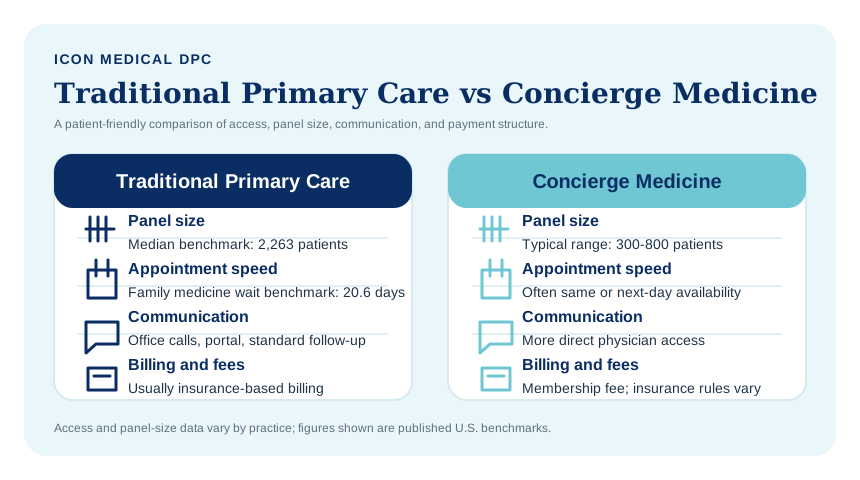
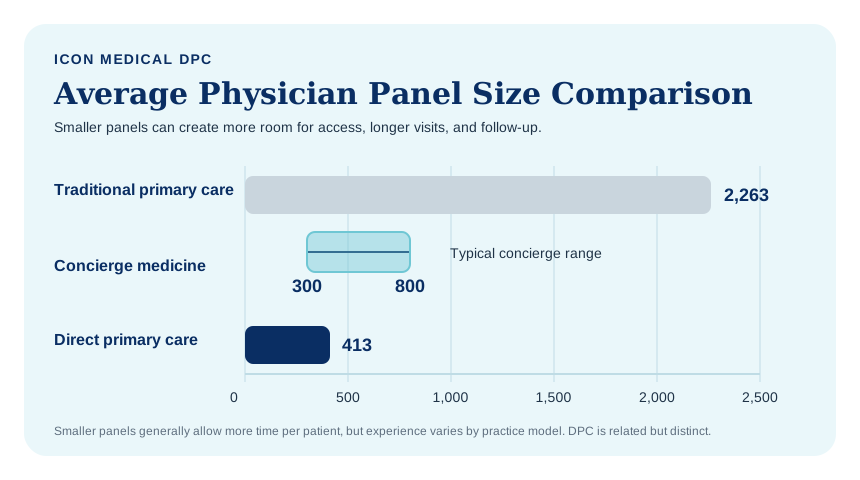
The most important structural difference between traditional primary care and concierge medicine is panel size. In standard U.S. primary care, a recent review on determining patient panel size in primary care found a median panel size of 2,263 patients in U.S.-based studies. Older and still widely cited work in primary care estimated the average panel around 2,300, and a 2022 update estimated that a doctor caring for a 2,500-patient panel would need more than a full day to deliver recommended preventive, chronic, and acute care plus documentation and inbox work.
Concierge medicine tries to solve that by shrinking the patient panel sharply. The AMA Journal of Ethics discussion of concierge medicine describes concierge practices as generally limiting panels to about 300 to 800 patients, rather than the 2,000-plus panels common in traditional primary care. AAFP’s 2024 DPC data place the average direct primary care panel at 413 patients.
The insurance relationship is where many patients need the most clarification. Traditional primary care generally bills insurance in the usual fee-for-service way. Direct primary care typically charges a monthly or annual fee and does not bill insurance for most covered primary care services. Concierge medicine can look more hybrid: a concierge practice may charge a membership fee for enhanced access and still bill private insurance or Medicare for covered services, depending on the model and the doctor’s participation status.
Florida adds another practical layer for local patients. The Florida direct health care agreements statute says a direct health care agreement does not constitute insurance and is not subject to the Florida Insurance Code. It also requires written disclosure of covered services, extra fees, duration, renewal, and termination rules.
Average Physician Panel Size Comparison
What the Evidence Says About Benefits and Tradeoffs
The strongest arguments in favor of concierge medicine are rooted in things we already know matter in primary care: continuity, easier access, better follow-up, and more time for prevention and chronic disease management. Healthy People 2030 links a usual source of care with higher use of recommended preventive services, and continuity research links enduring physician relationships with lower mortality.
In the JAMA Network Open study mentioned earlier, people who used membership-style clinics for most of their primary care had higher primary care spending but lower total healthcare costs in matched analyses. These findings do not prove that every concierge membership improves outcomes, but they support the underlying theory that accessible, relationship-based primary care can be valuable.
That said, patients should know that the evidence base for concierge medicine itself is still limited. The American College of Physicians has noted limited evidence on the impact of concierge and direct patient contracting models on quality, cost, and access to care. In other words, the patient-experience benefits are easier to observe than definitive improvements in hard clinical outcomes across the whole model.
There are also legitimate system-level concerns. A 2023 study highlighted by Penn’s Leonard Davis Institute found that concierge medicine drives higher health costs without extending lives during the study period. Ethical discussions have also argued that VIP-style and concierge-style access can worsen inequity if scarce physician time is pulled toward patients with greater ability to pay rather than greater medical need.
The most reasonable patient conclusion is this: concierge medicine may be a very good fit for some people, especially those who highly value continuity and immediate access, but it should not be described as a universally proven substitute for excellent traditional primary care. The right question is not “Is concierge medicine better in every way?” The right question is “Does this model solve the problems that matter most in my care?”
Who May Benefit Most and What Sarasota Patients Should Ask
Based on how membership medicine is structured, the people most likely to benefit are often those who need more touchpoints, more coordination, or more access than traditional scheduling easily allows. That can include older adults managing multiple conditions, people on several medications, caregivers helping a parent or spouse, patients who travel often, seasonal residents who need continuity when they are in Sarasota, and busy professionals who do not want routine care to be delayed until a minor issue becomes urgent.
On the other hand, concierge medicine may not be necessary for every patient. If you already have excellent access to a trusted primary care clinician, use the office only occasionally, and are cost-sensitive, a membership fee may not add enough value to justify the extra out-of-pocket expense. This is especially important for Medicare beneficiaries, because Medicare does not cover concierge membership fees.
For patients comparing concierge medicine Sarasota options, the best approach is to think like a careful consumer and a careful patient at the same time. Ask for the written contract. Ask whether the physician bills insurance, accepts Medicare assignment, or has opted out. Ask what communication channels are included, how after-hours issues are handled, whether labs and imaging are discounted or billed separately, and what happens if you want to leave the practice.
A patient checklist before joining
- What exactly does the membership fee include?
- Which services are billed to insurance or Medicare, and which are not?
- Do I have direct physician access by phone, text, portal, or email?
- Are same-day or next-day appointments part of the normal workflow or only “when available”?
- What labs, imaging, procedures, or medications cost extra?
- How does the practice handle specialist referrals, hospital follow-up, and after-hours concerns?
- If I am a Medicare patient, what is the physician’s Medicare participation status?
- If I am a seasonal Sarasota resident or traveler, how is care handled when I am away?
For local readers evaluating Icon Medical specifically, the practice states that it offers concierge primary care in Sarasota, same-day and next-day appointments, unlimited telemedicine, and direct communication access, and it is led by Dr. Josephine Olsen, a board-certified family physician. Patients can also review membership medicine options, meet Dr. Josephine Olsen, or learn about pilot medical exams in Sarasota when those services are relevant.
The Bottom Line
Concierge medicine is best understood as a membership-based approach to primary care that trades a recurring fee for more time, more continuity, and more direct access to a physician. For many patients, especially those frustrated by long waits or rushed visits, that can feel like a meaningful improvement in how care is delivered.
But concierge medicine is not automatically the best choice for everyone. It does not replace hospital coverage. It does not always replace insurance. Medicare does not cover the membership fee. And while some evidence supports the benefits of accessible, relationship-based primary care, the evidence for concierge medicine itself remains more limited than the marketing around the model sometimes suggests.
The most patient-centered way to think about the model is simple: if you want a concierge doctor because you need better access, easier communication, and more personalized healthcare, concierge medicine may be worth serious consideration. If your current primary care already gives you those things, a membership fee may not change much. Either way, the best decision starts with a written contract, a clear understanding of insurance and Medicare rules, and an honest assessment of what kind of primary care relationship you actually need.
Have questions about whether this model fits your care needs? Contact Icon Medical to ask about membership details and next steps.
Frequently Asked Questions
What is concierge medicine?
Concierge medicine is a membership-based model of care in which patients pay a recurring fee for enhanced physician access, smaller patient panels, and more personalized primary care.
Is concierge medicine the same as direct primary care?
Not exactly. The terms overlap, but direct primary care usually charges a lower monthly fee and generally does not bill insurance for most primary care services, while concierge practices may still bill insurance or Medicare for covered care.
Does concierge medicine replace health insurance?
Usually no. Most patients still need insurance or Medicare for hospitalization, emergency care, imaging, specialist visits, and other services not included in the membership.
Does Medicare cover concierge medicine fees?
No. Medicare does not cover concierge membership fees, and patients should ask how the practice handles Medicare billing, assignment, and opt-out status before enrolling.
Is concierge medicine available in Sarasota?
Yes. Sarasota patients can find concierge-style and membership-based primary care options locally, but they should compare contracts, service scope, Medicare participation, and communication access before joining.